
Catalog Windsor City Directory Runs
Windsor city directory research crosses several holders. Regional Hartford books may include suburban material, but Windsor coverage must be checked volume by volume. The Windsor Historical Society preserves local directories and address files. The public library holds town histories, yearbooks, and genealogy tools. Digitized telephone books add a later layer. The table states only the verified run or example.
| Windsor collection | Verified span/example | Holder | Access and limit |
|---|---|---|---|
| Geer's Hartford City Directory | 1838–1920/21; 92-volume catalog record | NYPL and regional catalogs | Hartford-centered; Windsor inclusion is not verified for every year |
| Greater Hartford continuation | 1921/22–1927/28, with later continuation leads | Regional library holdings | Check each volume for actual Windsor pages |
| Hartford Suburban Directory | 1909–1910 page | Windsor Historical Society | Digitized page showing trolley-stop address style |
| WHS local directories and house files | Seventeenth–twentieth-century material; 250+ address files | WHS Research Library | On-site or staff inquiry, Wed–Sat 11–4 |
| Hartford telephone directories | 1960/61, 1962/63, 1972/73, 1974/75 examples | Library of Congress | Digitized white/yellow pages and local calling context |
| Yearbooks and obituary files | Collection-specific; full year run not published | Windsor Library and WHS | Catalog, finding aid, in-library database, or inquiry |
No complete official Windsor-only publisher-and-year inventory was located. Do not infer that a Hartford title includes Windsor in every volume, or that a gap marks a family's absence.
Before requesting a volume, give the librarian a surname, likely year, Windsor village or road, and any known business or family link. Ask whether the title has a street-order section and whether Windsor appears in the main alphabetical list, a suburban supplement, or only a telephone exchange map. For an online item, save the catalog record as well as the scanned page. The catalog proves title and date; the page proves the entry. That split keeps a regional Hartford directory from being mislabeled as a Windsor-only publication.
The NYPL Geer's Hartford catalog record documents the long regional run.
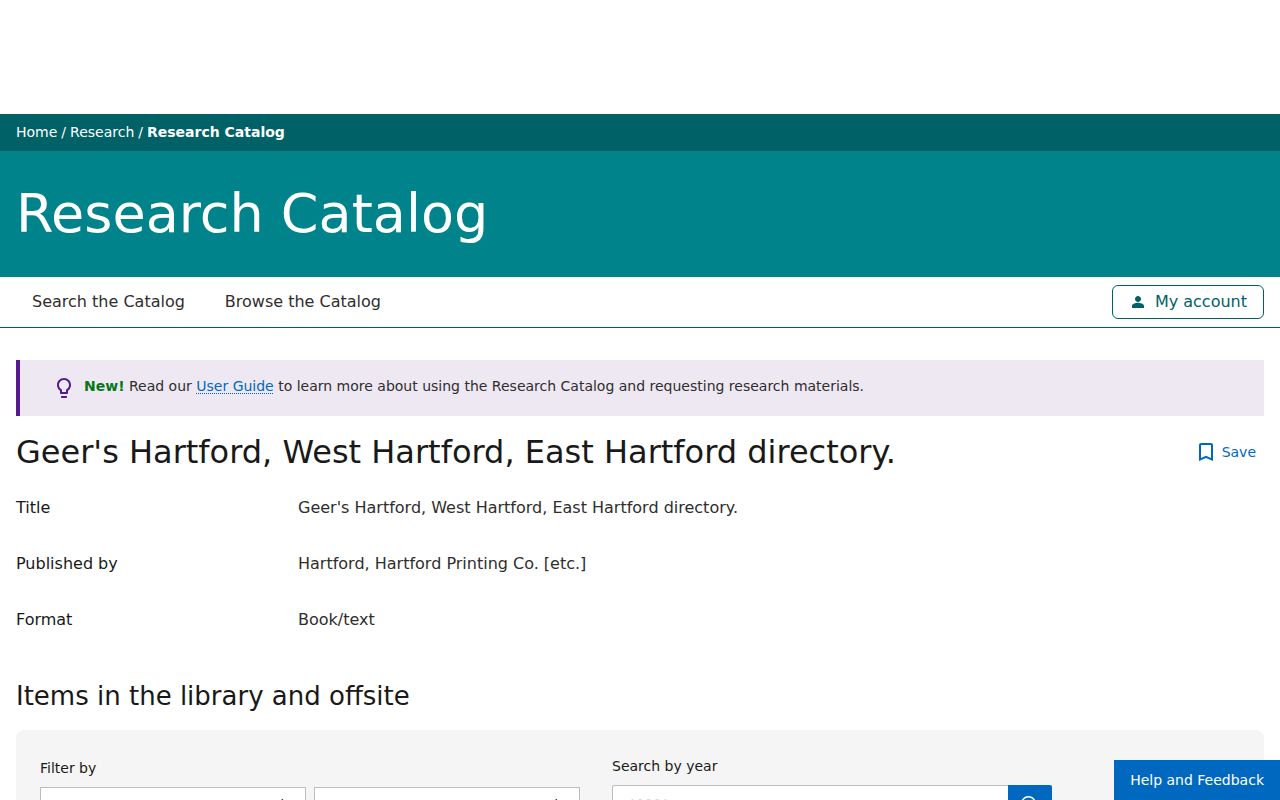
The catalog is a coverage lead, not proof that a named Windsor household appears in a given year.
Collection access also changes by format. A catalog entry may lead to a bound volume, microfilm, scanned book, single photographed page, or on-site reference item. Ask whether copying is allowed and whether staff can check an index before a visit. For a digital volume, capture the title page, publication date, coverage statement, abbreviation key, and entry page. Those supporting pages matter when several Hartford-area titles have similar names. If Windsor appears only in a suburban section, include that section heading in the citation. Never smooth an uncertain year range into a complete run.
Use Windsor Library Genealogy Sources
The Windsor Public Library genealogy page points to local books, periodicals, yearbooks, town history, and genealogy. Named works include Stiles, Howard, Fowles and Uricchio, and the Town of Windsor Historic Survey. The library also routes researchers to the historical society, Connecticut State Library, Connecticut Historical Society, founders' and genealogy groups. Ancestry Library Edition is available at the Main Library or Wilson Branch, not as open home access.
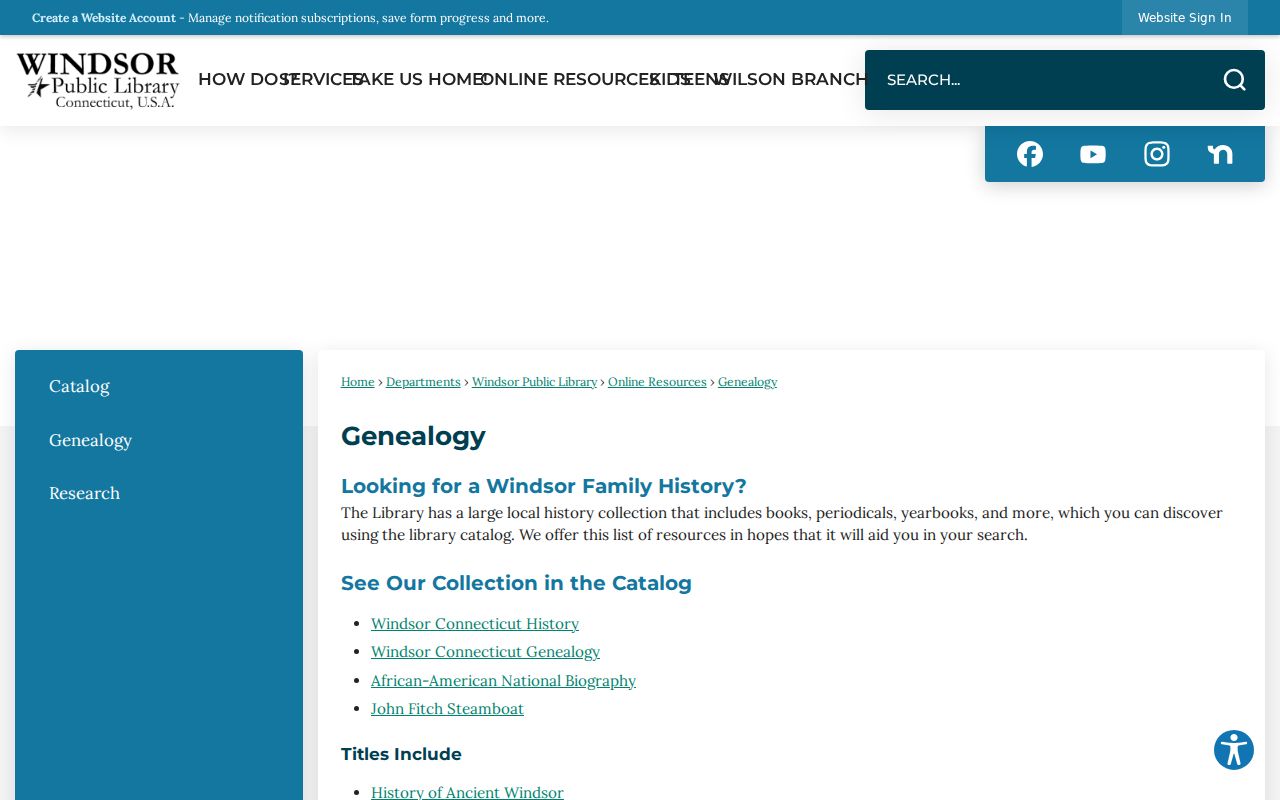
The library route supplies books and databases that can explain a name or place between directory years.
Local histories add context that a terse listing lacks. They can identify a village, public institution, factory, school, or family name, then send the researcher back to the original directory. Yearbooks can confirm a dated school association. Periodicals may carry an obituary or anniversary note. Fold3 and the in-library genealogy database can add military, census, and other historical sources under their own access terms. A library database result should still be cited by its record collection and date, not merely as a “library search.”
Bring a short research log to the library. List every name variant, spouse or widow notation, known road, village, likely years, and the title already checked. Record negative searches too. A missing entry in one Hartford volume may reveal that the wrong geographic edition was used. Staff can help identify a catalog title or collection, but the researcher should not ask them to establish a living person's current address.
Search Windsor Historical Society Files
The WHS Research Library holds directories, newspapers, school yearbooks, maps, oral histories, cemetery and vital material, photographs, family papers, and more than 350 published Windsor genealogies. Its finding aids add subject files, obituaries, address-based house files, and a Town Crier index covering 24 issues from 1916–1917. Research hours are Wednesday through Saturday, 11 to 4.
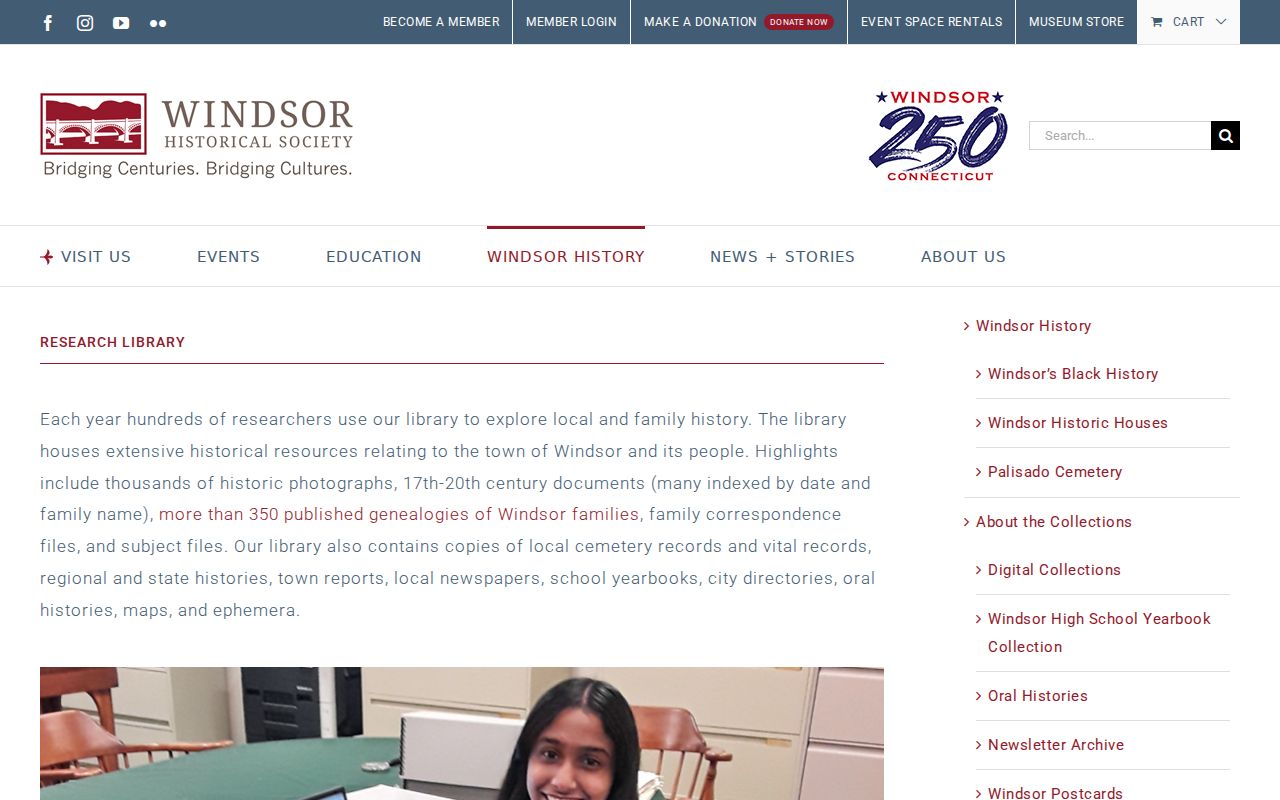
Those files can link a directory name to a photograph, family record, obituary, or specific property while preserving the source date.
Finding aids are often the fastest first pass. A subject file may reveal a surname or trade. A Houses-series file starts with an address. The Old Document Index uses volume/document number, year, document type, name, and a short description, which can surface an early deed or will before the researcher knows the official book reference. WHS material remains a discovery layer. Verify a recorded instrument through the Windsor Town Clerk when the legal transaction matters.
The research library lists thousands of photographs and seventeenth–twentieth-century documents indexed by family and date. Family correspondence can distinguish two people who share a name. Maps and postcards can preserve a street or institution that disappeared. Oral histories offer leads, but they remain recollections and need comparison with dated records. Cemetery and vital material may close a family trail subject to access rules. Ask about the specific file, collection, and reproduction policy before visiting.
Decode Windsor Trolley-Stop Listings
Windsor house numbers were not assigned until 1915. The local 1909–1910 directory therefore used trolley stops, including Wilson Congregational Church at 6½, Windsor Public Library at 28, Thrall School at 44, and Rainbow center at 70. A present-day number search can fail even when the person is in the volume.
The digitized suburban directory page shows that address system.

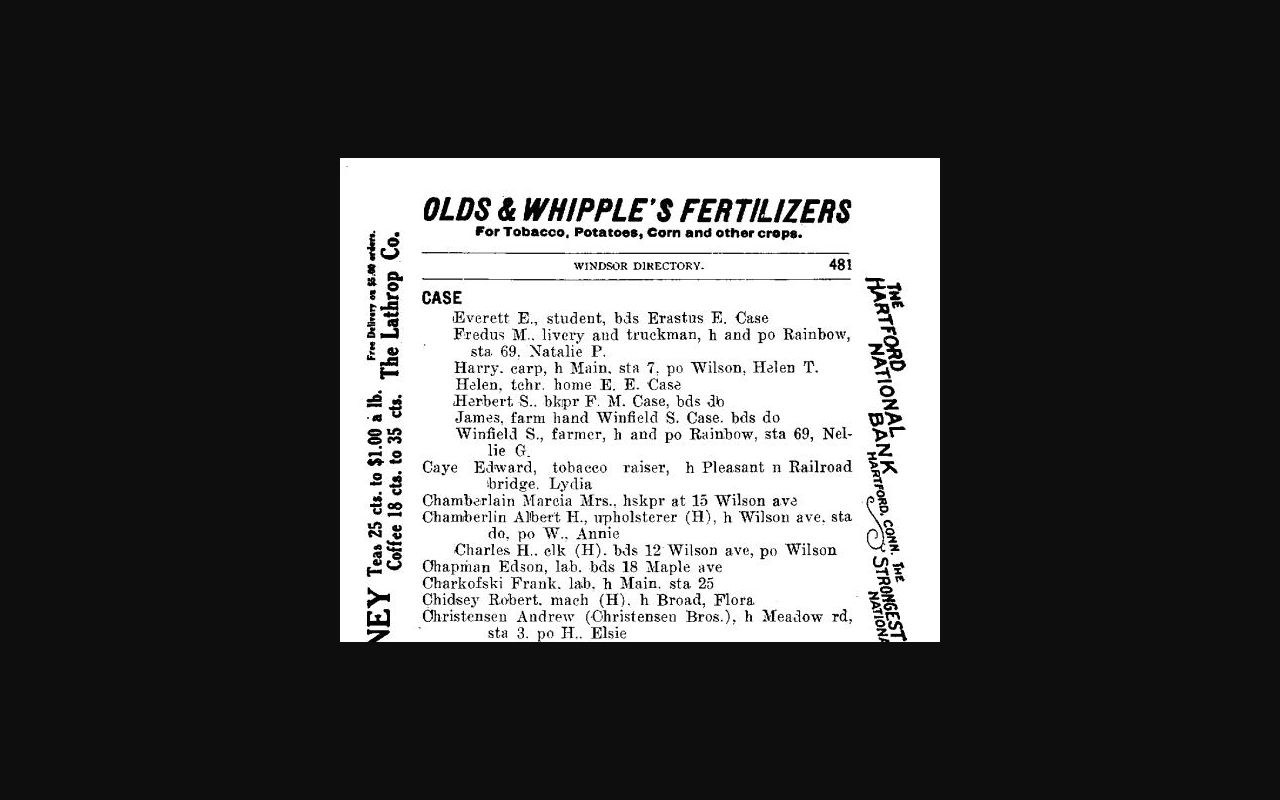
Translate the listing through its village, landmark, road, map, and deed before assigning it a modern address.
Keep the stop number exactly as printed. Next, identify the institution or village attached to it, then compare a period map and later numbered directory. Windsor center, Poquonock, Rainbow, and Wilson can all appear as place labels. “Ancient Windsor” can also describe a larger historic area that later became parts of Windsor Locks, East Windsor, Bloomfield, South Windsor, and other towns. A historical place name therefore needs a date and geographic check before it is normalized to today's town.
The trolley-stop system is also a warning about alphabetical searches. A person can be present under a name yet hard to place on a modern street. Conversely, a stop or institution can describe the nearest landmark, not the exact parcel. Follow the name into consecutive directory years and watch for the shift to numbered addresses after 1915. Then compare the legal description or house file. A neat one-to-one conversion should not be claimed unless the sources truly support it.
Read a Windsor Directory Entry
Transcribe the whole entry before interpreting it. A name may include a spouse or widow notation. An occupation or business can point to a workplace rather than a home. Early Windsor geography may be a village or trolley stop. A later telephone listing may give an exchange and number. Photograph or transcribe the volume's own abbreviation key, because the exact symbols were not recovered from the inspected 1909–1910 image.
| Name | Copy surname, given name, initials, and printed order exactly. |
|---|---|
| Spouse/widow line | Preserve the wording, but verify family ties in another record. |
| Occupation/business | Record the affiliation separately from the residence field. |
| Address | Copy street, village, number, trolley stop, or locality as printed. |
| Telephone/exchange | Useful in later books, but not proof of current occupancy. |
| Owner/boarder marks | Interpret only through that volume's abbreviation key. |
- Criss-cross directory
- A later address-first arrangement used to move from a street number to a listed name.
- Householder index
- A name or address listing centered on the person identified as head of a household.
- Abbreviation key
- The publisher's legend for marks and shortened terms, which must control the transcription.
Do not invent an owner or renter mark when the key is missing. Preserve the original text and state what remains uncertain.
Read neighboring entries as layout evidence, not as proof of physical neighbors. Alphabetical lists group surnames. Street-order lists group printed addresses, but their sequence may not match today's parcel order. Business sections can repeat a person under a firm name. Telephone white pages may omit members of the same family and place one subscriber at an address. Page headings and column rules reveal which kind of list is in use. Include them when saving a clipping.
Names also change shape. Initials, honorifics, widow notation, spelling errors, and a spouse's name can shift from year to year. Preserve the printed form before normalizing it in research notes. Do not merge two same-name residents until address, spouse, trade, directory date, or another record aligns. If evidence remains mixed, keep separate candidate identities.
Extend Windsor Directories by Phone
Library of Congress examples from 1960/61, 1962/63, 1972/73, and 1974/75 extend the local trail through Hartford-area telephone books. White pages can supply a name, exchange, and listed address; yellow pages add businesses. Local calling maps help define the region covered. A telephone entry is still a publication snapshot and may represent a business, shared phone, or stale listing.
Use consecutive books when possible. A one-year change may be a move, a new exchange, an omitted listing, or a publication error. Confirm it with a deed, census, obituary, or house file.
Telephone geography may extend beyond Windsor. Check the locality heading and calling-area material around the listing. A Hartford-area book can include Windsor without being a town directory, and a business listing can use a regional exchange. Record whether the page comes from white pages, yellow pages, a locality subsection, or an exchange map. These distinctions make later comparisons much more reliable.
Connect Windsor Names to Houses
WHS's Beverly Garvan house research combines deeds, tax assessments, probate, maps, and family genealogies. The house-file series covers more than 250 homes, businesses, and demolished properties. It is a strong companion to a Windsor city directory because the address, not just the surname, is the entry point.
The Windsor historic-house guide explains that method.
The guide also warns that current house numbers are early twentieth-century labels, so deeds and maps must bridge earlier descriptions.
House files can preserve demolitions and prior uses that no current parcel screen shows. Start with the modern address, but give WHS any known former number, owner, nearby institution, and map reference. Compare photos and notes with the deed chain. Tax assessments may date a major change; probate may explain transfer to heirs; a directory may place a listed household or business there. Each contributes one part of the story. None alone supplies uninterrupted occupancy.
Place Windsor Directories in Time
Windsor's directory story is regional and uneven. These milestones show why one catalog cannot stand in for the whole shelf.
| 1838 | Geer's Hartford catalog run begins. |
|---|---|
| 1855 | A Windsor business-directory reference identifies the Filley brickyard. |
| 1909–1910 | The surviving suburban page uses trolley-stop geography. |
| 1915 | Windsor house numbers are assigned, changing address search. |
| 1916–1917 | WHS Town Crier issues preserve local notices and names. |
| 1920s onward | Greater Hartford and later telephone books extend regional coverage. |
No verified last printed Windsor-specific year was found. Report the actual title and date of every source used.
The timeline also crosses other record systems. Windsor land indexes reach far earlier than city directories. State vital registration begins in the late nineteenth century, while town records are older. Public census releases occur under a federal delay. A directory fills annual or periodic gaps but reflects the publisher's choices. Aligning these clocks is more useful than seeking one “complete” historical resident list.
Trace Families in Windsor Directories
Build a citation ledger before building a family timeline. Record the directory title, stated coverage, publisher, year, page, section, printed name, printed address, and repository. Add a separate column for the modern interpretation. This prevents a later road name or house number from being silently inserted into the transcription. When an entry comes from a regional Hartford title, note the Windsor subsection or locality heading. When it comes from a single photographed page, do not imply that the entire volume has been reviewed.
Next, group evidence by person and by place. A surname timeline can show moves, changes in trade, spouse notation, or a disappearance. An address timeline can show successive listed households or businesses. They are related but not identical. Two people with the same surname may share neither family nor address. Likewise, one building can have a listed business and a different owner. Cross-check middle initials, spouse names, occupations, deed parties, probate roles, and dates before merging records.
Census pairing works best when its limits are explicit. A released federal schedule shows a household on its enumeration date. Directories can add observations before and after that date. For 1890, Windsor researchers do not have the missing federal schedule, so WHS's reconstruction uses local sources. For later decades, compare the directory entry with the nearest available census but allow for moves and publication lag. The absence of a renter, boarder, woman recorded under a spouse, or rural household can reflect publisher practice rather than actual absence.
Deeds and probate can explain property transitions. Begin with the named owner only when the directory or another source supports that role. A deed's grantor and grantee document a transfer; they do not list the whole family. Probate may name a decedent, fiduciary, or heir and can explain why title moved after a death. An obituary can connect relatives and a former place, while a cemetery record can add a burial date. Each result should remain tied to its keeper and record date.
Windsor business history provides another route. WHS notes a Filley brickyard in an 1855 Windsor business directory. Eddy Electric appears in Windsor history and in an 1893 Hartford City Directory advertisement. Such entries are dated business and address anchors. They are not home-address proof. Search the business name, owners, advertisements, trade records, newspapers, and subject files separately, then compare any personal listing. This is often more accurate than assuming the workplace line in a city directory describes residence.
When research ends at a gap, describe the next access channel. Ask Windsor Public Library about a title or yearbook. Ask WHS about a subject, family, house, obituary, or Town Crier file. Consult the Connecticut State Library or regional catalog for a Hartford volume. Use the Library of Congress for digitized telephone books. Verify land records through the Windsor Town Clerk. A clear “not found in the checked volume” is more useful than a broad claim that no record exists.
City directories can bridge the long space between census years. Begin with a verified name and place, compare consecutive volumes, and note every change in spelling, household notation, trade, and address. Public federal census access reaches 1950 under the 72-year rule. Windsor's 1890 federal schedule is unavailable, so the historical society's reconstruction is a distinct local source rather than a recovered census.
- Find the earliest verified entry and copy the title, year, page, and full line.
- Check the prior and next available volumes for spelling changes, moves, or a missing year.
- Translate trolley stops, villages, and old road forms before comparing a modern address.
- Pair the result with a released census, deed, probate file, yearbook, or WHS house file.
- Use obituary, cemetery, and Town Crier material to test a death or family link.
Disappearance does not prove death or departure. The person may be omitted, unlisted, recorded under a spouse, or outside that volume's regional scope. Mark the gap and test it elsewhere.
WHS rebuilt an 1890 Windsor census substitute from tax, voting, vital, church, and funeral-home records. It reports 296 farmers and more than 1,200 cows, a vivid reminder that several local record types can restore context lost from one national source.
Treat the reconstruction as an authored local dataset, not a federal schedule. Its heads of household and supporting indicators come from named substitute sources. Cite the reconstruction, then inspect its supporting tables for the exact claim. This method is a model for other gaps: state what is missing, identify the sources used to bridge it, and keep the reconstructed conclusion distinct from the original record.
Obituaries and probate records can explain a surname change, death, or transfer to heirs. Yearbooks provide a dated school link. Telephone books extend an address trail but may omit unlisted people. Cemetery and church material can support family context where access permits. None should be stretched beyond its purpose. A useful family-history note reads “listed at this address in this publication and year,” then cites the page. That wording preserves the strongest fact without turning a historical city directory entry into a claim about present residence.